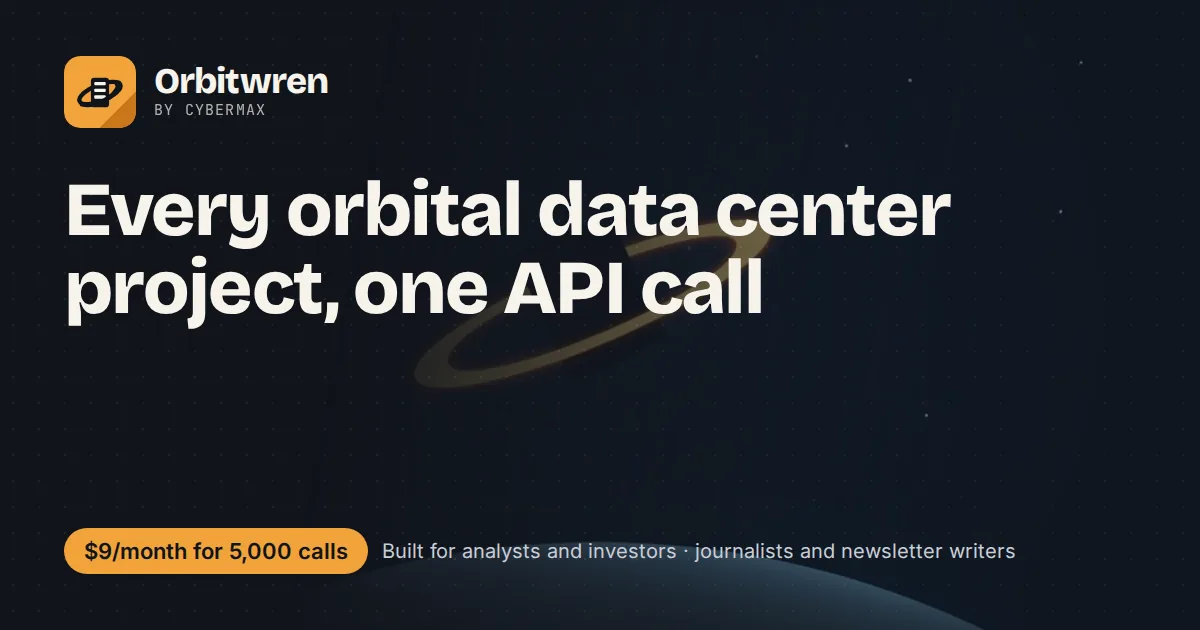
Every orbital data center project, one API call
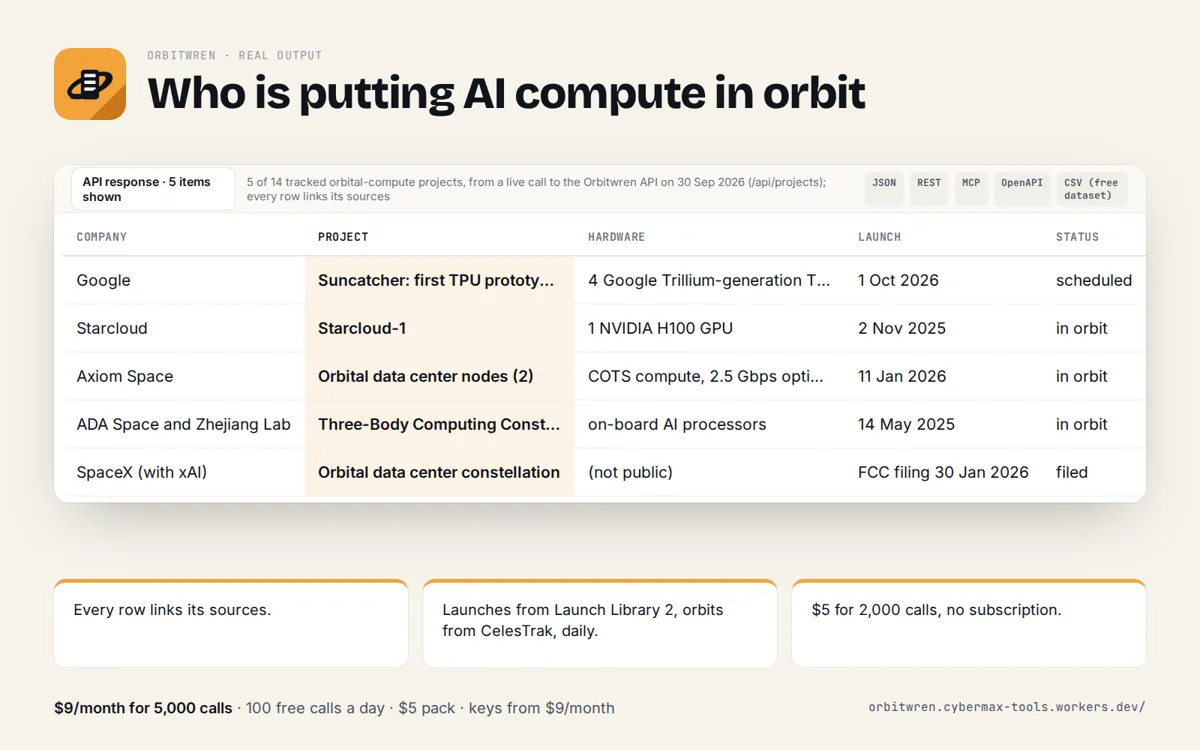
Who is putting AI compute in orbit, on what hardware, and when: Google's Project Suncatcher, Starcloud, SpaceX, Blue Origin, Axiom, Aetherflux and more, each row with its sources. Plus the next launches (rideshares flagged), live orbits from CelesTrak and a daily change log. For analysts, investors, journalists, space and AI builders, and AI agents. Free tier, no key; plans from $9/month.
Opens Stripe's billing portal: invoices, payment method, cancel.
Who it's for
Anyone following the race to put AI compute in orbit: one clean, sourced table instead of a dozen press releases, with the launches and orbits next to it.
Every project with its status, hardware, dates and publicly stated funding, and a change log you can diff.
Who launched what and when, each fact with the source link, ready to cite.
Upcoming rideshares, compute launches and live orbits in JSON, without scraping.
An MCP server that answers "what orbital compute is launching next?" with sources.
Try it
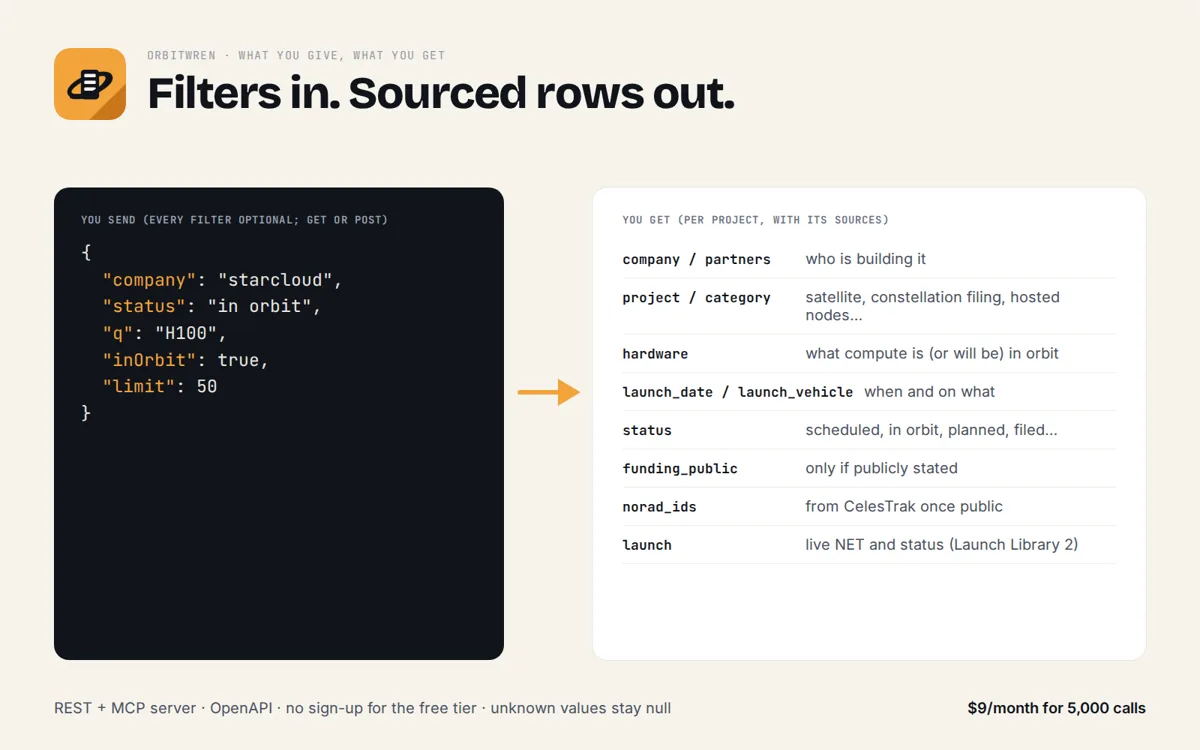
The orbital compute tracker, live. Filter by company, status or a word such as TPU, H100 or constellation.
Raw JSON response
Real sample output
Captured from a live call to this API (first 2 rows).
{
  "query": {
    "company": null,
    "status": null,
    "category": null,
    "q": "TPU"
  },
  "count": 2,
  "projects": [
    {
      "id": "google-suncatcher-tpu-prototype",
      "company": "Google",
      "partners": [
        "Planet"
      ],
      "project": "Project Suncatcher: first TPU prototype satellite",
      "category": "prototype satellite",
      "hardware": "4 Google Trillium-generation TPUs",
      "launch_date": "2026-10-01",
      "launch_date_text": "1 Oct 2026 (Transporter-18, window opens 18:18 UTC)",
      "launch_vehicle": "SpaceX Falcon 9",
      "launch_mission": "Transporter-18 rideshare, Vandenberg SLC-4E",
      "ll2_launch_id": "67213393-7983-4c06-8b44-b8c785a5ed79",
      "status": "scheduled",
      "scale": "1 satellite",
      "funding_public": null,
      "norad_ids": [],
      "celestrak_names": [
        "SUNCATCHER"
      ],
      "summary": "Google's first TPUs in orbit, on a prototype satellite developed with Planet, to measure how the chips handle launch stress, radiation and thermal extremes in low Earth orbit.",
      "sources": [
        {
          "publisher": "Google (blog.google)",
          "date": "2026-09-24",
          "url": "https://blog.google/innovation-and-ai/models-and-research/google-research/google-project-suncatcher-facts/",
          "fact": "First TPUs go to orbit on SpaceX's Transporter-18 rideshare, developed in partnership with Planet"
        },
        {
          "publisher": "Gizmodo",
          "date": "2026-09-24",
          "url": "https://gizmodo.com/googles-project-suncatcher-is-sending-ai-chips-into-space-next-week-2000816985",
          "fact": "Four Google TPUs (Trillium) launch next week on Transporter-18"
        },
        {
          "publisher": "The Space Devs Launch Library 2",
          "date": "2026-09-30",
          "url": "https://ll.thespacedevs.com/2.3.0/launches/67213393-7983-4c06-8b44-b8c785a5ed79/",
          "fact": "Transporter 18: NET 2026-10-01T18:18:00Z, status Go, SLC-4E"
        }
      ],
      "verified_on": "2026-09-30",
      "auto_norad_ids": [],
      "launch": {
        "name": "Falcon 9 Block 5 | Transporter 18 (Dedicated SSO Rideshare)",
        "net": "2026-10-01T18:18:00Z",
        "status": "Go",
        "status_name": "Go for Launch",
        "window_start": "2026-10-01T18:18:00Z",
        "window_end": "2026-10-01T19:16:00Z",
        "source_url": "https://ll.thespacedevs.com/2.3.0/launches/67213393-7983-4c06-8b44-b8c785a5ed79/"
      },
      "source_urls": [
        "https://blog.google/innovation-and-ai/models-and-research/google-research/google-project-suncatcher-facts/",
        "https://gizmodo.com/googles-project-suncatcher-is-sending-ai-chips-into-space-next-week-2000816985",
        "https://ll.thespacedevs.com/2.3.0/launches/67213393-7983-4c06-8b44-b8c785a5ed79/"
      ]
    },
    {
      "id": "google-planet-suncatcher-pair",
      "company": "Google",
      "partners": [
        "Planet"
      ],
      "project": "Project Suncatcher: two prototype satellites with cross-links",
      "category": "prototype satellites",
      "hardware": "Google TPUs (per satellite count not stated)",
      "launch_date": null,
      "launch_date_text": "early 2027 (target)",
      "launch_vehicle": null,
      "launch_mission": null,
      "ll2_launch_id": null,
      "status": "planned",
      "scale": "2 satellites flying in tandem with high-bandwidth cross-links",
      "funding_public": null,
      "norad_ids": [],
      "celestrak_names": [],
      "summary": "Planet builds and operates two prototype satellites for Google to test TPUs working together over high-bandwidth inter-satellite links.",
      "sources": [
        {
          "publisher": "Planet (planet.com)",
          "date": "2025-11-04",
          "url": "https://www.planet.com/pulse/planet-to-build-and-operate-advanced-space-platform-for-project-suncatcher-moonshot/",
          "fact": "Planet will deploy two prototype satellites for Google, targeting a launch by early 2027"
        },
        {
          "publisher": "Google (blog.google)",
          "date": "2026-09-24",
          "url": "https://blog.google/innovation-and-ai/models-and-research/google-research/google-project-suncatcher-facts/",
          "fact": "We'll test our work on this in 2027 when we put two satellites in orbit"
        }
      ],
      "verified_on": "2026-09-30",
      "auto_norad_ids": [],
      "source_urls": [
        "https://www.planet.com/pulse/planet-to-build-and-operate-advanced-space-platform-for-project-suncatcher-moonshot/",
        "https://blog.google/innovation-and-ai/models-and-research/google-research/google-project-suncatcher-facts/"
      ]
    }
  ],
  "data": {
    "projects_verified_on": "2026-09-30",
    "launches_updated": "2026-09-30T18:59:06Z",
    "orbits_updated": "2026-09-30T18:59:48Z",
    "source": "Orbitwren curated tracker by CyberMax: every row cites its source URLs; unknown values are null, never estimated.",
    "note": "Company names identify projects only; no affiliation with or endorsement by any company listed. Unknown values are null, never estimated."
  },
  "limits": {
    "requestsPerMinutePerIp": 20,
    "rowsPerCall": 100,
    "timeoutSeconds": 10
  }
}
Limits, plainly
Free and rate limited so it stays fast for everyone. Up to 100 rows per call. The free Hugging Face dataset has the daily snapshot as CSV; the API adds filters, the countdown, orbits and the change log for your code and agents.
- Up to 100 rows per call; 20 calls a minute per IP on the free tier.
- Free tier: 100 calls a day per IP, no key. Paid keys from $9/month (see Get an API key).
- Tracker rows are verified by hand against company pages and reputable news; unknown values are null, never estimated. Launches (The Space Devs Launch Library 2) and orbits (CelesTrak) refresh daily; every response says when.
- Company names identify projects only; no affiliation with or endorsement by any company listed. Unknown values are null, never estimated.
Rather read it than call it?
The live tracker page has the whole table, the launch countdown and every source link, free. The daily CSV snapshot is on Hugging Face.
Get an API key
Orbital compute and space data center tracker API: every public project putting AI compute in orbit (Google's Project Suncatcher, Starcloud, SpaceX, Blue Origin, Axiom Space, Aetherflux and more) with company, hardware in orbit, launch date, status, publicly stated funding and a source link for every fact; the next 200 orbital launches from The Space Devs Launch Library 2 with rideshare and compute flags; CelesTrak orbits for the compute satellites; the next compute launch with a countdown; and a daily change log. Keys work on the REST API and the MCP server.
20,000 calls a month · 60 per minute
Get Analyst keyor $190/year, 2 months freePay with card, Apple Pay, Google Pay or Link through Stripe Checkout (sales tax/VAT handled by Stripe). Your key appears on the page you return to right after checkout: save it. Manage or cancel any time at orbitwren.cybermax-tools.workers.dev/manage. Send it as x-api-key: YOUR_KEY (or Authorization: Bearer YOUR_KEY, which MCP clients support). Check usage at /key. Failed calls are not counted. Launch-data APIs are cheap but have no compute tracker: RocketLaunch.live's API comes with its Premium membership (pay what you wish, $3/month minimum) and The Space Devs Launch Library 2 is free at 15 requests an hour (higher limits for Patreon supporters); space-industry research is reading, not data: Payload Pro is $999 a year (checked 30 Sep 2026). Orbitwren is the data layer for the orbital-compute race: 100 free calls a day, $5 for 2,000 calls, or $9/$19/$49 a month.
curl -s "https://orbitwren.cybermax-tools.workers.dev/api/projects?..." -H "x-api-key: YOUR_KEY"

# MCP (Claude Desktop, Cursor, VS Code)
{ "mcpServers": { "orbitwren": { "type": "http", "url": "https://orbitwren.cybermax-tools.workers.dev/mcp",
  "headers": { "Authorization": "Bearer YOUR_KEY" } } } }

# Usage so far
curl -s https://orbitwren.cybermax-tools.workers.dev/key -H "x-api-key: YOUR_KEY"
Use the API
JSON over HTTPS, CORS enabled, no key. GET for quick calls, POST a JSON body for lists. Spec: openapi.json · llms.txt
curl -s "https://orbitwren.cybermax-tools.workers.dev/api/projects?"

# lists: POST a JSON body
curl -s -X POST https://orbitwren.cybermax-tools.workers.dev/api/projects \
  -H "content-type: application/json" \
-d '{"company":"starcloud"}'import requests
r = requests.post("https://orbitwren.cybermax-tools.workers.dev/api/projects",
json={"company":"starcloud"}, timeout=30)
r.raise_for_status()
for row in r.json()["projects"]:
print(row)Endpoints: /api/projects orbital compute and space data center projects, with sources · /api/launches upcoming orbital launches, rideshare and compute launches flagged · /api/next the next orbital-compute launch, with a countdown and what is on board · /api/orbits orbit elements for orbital-compute satellites (celestrak) · /api/changes day-to-day change log: status, launch dates, norad ids · /api/status data freshness and counts (free, not metered)
Add it to your AI agent (MCP)
A remote MCP server at https://orbitwren.cybermax-tools.workers.dev/mcp (streamable HTTP, no auth). Read-only tools with JSON schemas, so agents know exactly what to send.
// Claude Desktop, Cursor, VS Code, any MCP client (remote, no key)
{
  "mcpServers": {
    "orbitwren": { "type": "http", "url": "https://orbitwren.cybermax-tools.workers.dev/mcp" }
  }
}

# Claude Code
claude mcp add --transport http orbitwren https://orbitwren.cybermax-tools.workers.dev/mcp

# Tools: orbital_compute_projects, next_compute_launch, upcoming_launches, compute_satellite_orbits, tracker_changes
# e.g. orbital_compute_projects({"q":"TPU"})
orbital_compute_projects
Orbital compute / space data center projects: company, partners, hardware in orbit, launch date, vehicle, status, scale, publicly stated funding, NORAD IDs and source URLs. Filter by company, status, category or text.next_compute_launch
The next launch carrying a tracked orbital-compute project, with NET, window, status, seconds to launch and the projects on board.upcoming_launches
Upcoming orbital launches from The Space Devs Launch Library 2 with rideshare and orbital-compute flags; filter by days ahead, rideshare, compute, provider, country or text.compute_satellite_orbits
CelesTrak orbit elements with perigee/apogee and period for tracked orbital-compute satellites (by NORAD ID or project).tracker_changes
Day-to-day changes: project status, launch dates, NORAD IDs, tracked launch NET/status.
FAQ
Why not follow the news, or the free Launch Library?
Launch Library 2 is one of our sources and it is excellent, but it lists launches, not which ones carry AI compute, and its free tier is 15 requests an hour. The orbital-compute story is spread over company blogs, FCC filings and news. Orbitwren joins them into one sourced table, flags the compute launches and adds orbits and a change log, as JSON and MCP.
Why not Payload Pro or a market report?
Payload Pro is $999 a year for analysis and reports across the whole space industry (pro.payloadspace.com, 30 Sep 2026); it is reading, not an API. Launch-data APIs such as RocketLaunch.live start at $3 a month but have no compute tracker. Orbitwren is the data layer for this one fast-moving niche: 100 free calls a day, $5 pay-as-you-go, or $9/month.
How do you decide what is in the tracker?
A project is listed when a company page or a reputable news outlet describes a concrete orbital-compute or space data center effort: hardware in orbit, a scheduled or planned satellite, an FCC constellation filing, or a hardware platform built for it. Every row links its sources and the fact each supports. Values nobody has published are null, never estimated.
Where do NORAD IDs and orbits come from?
CelesTrak. A satellite gets IDs only once they are public in CelesTrak's catalog; until then the field is empty. The daily build also searches CelesTrak by name for tracked satellites (for example after the 1 Oct 2026 Transporter-18 launch) and fills auto_norad_ids when a match appears.
How fresh is it?
Launches and orbits refresh every day; tracker rows are re-verified when news breaks. Every response has data.launches_updated, data.orbits_updated and data.projects_verified_on, and /api/changes lists what moved.
Is there a key or a cost?
The free tier needs no key: 100 calls a day per IP. Paid keys: Watch $9/month for 5,000 calls, Analyst $19/month for 20,000 calls, Desk $49/month for 100,000 calls; or pay as you go: $5 for 2,000 calls that never expire. Yearly billing gives 2 months free. Every call returns up to 100 rows. Send the key as the x-api-key header. No surprise overage charges; cancel any time.
Can I use it from Claude, Cursor or another AI agent?
Yes. Add the MCP server URL below (with your key as a Bearer token for paid limits). Tools: orbital_compute_projects, upcoming_launches, next_compute_launch, compute_satellite_orbits and tracker_changes.
Are you affiliated with Google, SpaceX or the other companies?
No. Orbitwren is an independent CyberMax tracker. Company and project names are used only to identify what is tracked; nothing here implies endorsement.